I first started working with Open Austin in 2024. Open Austin is a volunteer organization that started as a chapter of Code for America and currently brings technologists together with civic organizations and non-profits to help improve the services offered by these organizations and offer them assistance anywhere they might need it.
Shortly after I joined Open Austin, they were contacted by the Austin Public Library. The Austin Public Library had a single developer working on their website who was didn’t have anyone with whom he could talk shop and learn new techniques, coming from an accumulated JavaScript frontend and Drupal backend toward modern web practices, and a single UX designer who had recently come over from graphic design in the marketing department and was learning UX on the fly. They came to Open Austin hoping that they could find other developers and designers to talk shop with and maybe even help them explore some of them problems with the website that they had been trying to figure out how to deal with.
The head of Open Austin, Liani Lye, brought this opportunity to work with the library to me as she thought it would be a good fit for my skill set and she needed assistance assessing how we should first engage with the library. After a brief discussion, she and I landed on conducting a goal setting workshop with our contacts at the Austin Public Library (APL) as well as some other stakeholders at the library, specifically in regards to the website.
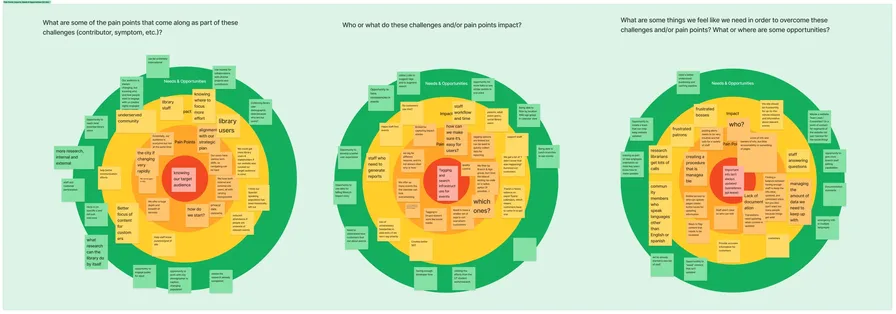
In January 2024, I designed and led a remote FigJam workshop to determine the shared priorities between Open Austin and APL. I designed the workshop and co-facilitated it with Liani while eight APL participants brought perspectives from UX, web development, business systems, marketing, public information, community engagement, and library services.
Design for a Decision
The workshop had to do more than collect ideas. In 75 minutes, the group needed to agree on where a small team with limited time could create the most value.
I designed the agenda as a sequence that narrowed the problem at each step:
- Set roles and decision maker. We introduced the cross-functional group and named APL’s UX designer as the decider so discussion could converge.
- Make the challenges visible. A time-boxed sticky note parking lot gave each discipline equal space before louder voices could frame the problem for everyone else.
- Separate pain points from opportunities. Three concentric maps moved the group through impacts, needs, and possible interventions rather than jumping from the first complaint to a feature.
- Turn themes into goals. We grouped the strongest ideas and then plotted candidate work on an effort vs. priority matrix.
- Commit to a next step. I synthesized the workshop into three high-level goals, then followed up with everyone after the session with SMART goals the team could use for planning.

The board was deliberately visual, but the facilitation carried the method. Liani and I kept the group moving between silent contribution, discussion, clustering, and decision-making. That rhythm let specialists disagree without turning the session into either a presentation or an open-ended brainstorm.
What We Chose
The three broad goals were:
- keep staff aware of current training resources and refresh them regularly;
- prioritize search and events in the team’s workflow; and
- treat language access as access to critical information, including information in multiple languages.

The more consequential outcome was choosing the first service problem. The workshop surfaced meeting-room booking as a major source of pain: the existing system could let several people book the same room for the same time slot. Instead of attempting an abstract redesign of the entire library website, we focused the engagement on one public workflow with a clear failure, real users, and a boundary the small team could reason about.
That decision led to the Austin Public Library Meeting Rooms prototype, delivered in July 2026. It searches the library’s real inventory, exposes availability, persists requests, and covers the full request and cancellation lifecycle. Its schema rejects exact-start duplicates; overlapping reservation windows remain an explicit backlog item. This prototype is currently in the process of being tested with real users from the library as a way to gather feedback
What the Workshop Changed
The prototype took more than two years to reach delivery due to time constraints of a team who also had full-time jobs, but the workshop’s direction held throughout the entire time. It gave a new design and development team a shared vocabulary, turned a vague idea of a direction to head into a very specific goal for the Open Austin team, and established decision-making habits for APL that could outlast Open Austin’s involvement.